|
Record Information |
|---|
| Version |
1.0 |
|---|
| Update Date |
1/22/2018 12:54:54 PM |
|---|
|
Metabolite ID | PAMDB100093 |
|---|
|
Identification |
|---|
| Name: |
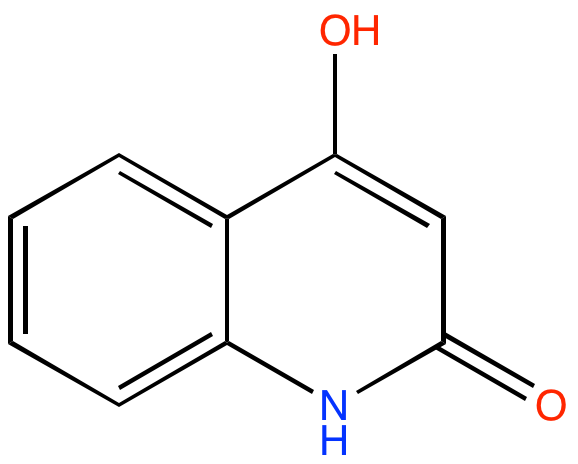
DHQ |
|---|
| Description: | Extracellular metabolite produced by the pqs operon in Pseudomonas aeruginosa. DHQ is the most abundant alkylquinolone species produced by the P. aeruginosa PQS biosynthetic pathway and may play a distinct role in maintaining P.aeruginosa pathogenicity. |
|---|
|
Structure |
|
|---|
| Synonyms: | |
|---|
|
Chemical Formula: |
C9H7NO2 |
|---|
| Average Molecular Weight: |
Not Available |
|---|
| Monoisotopic Molecular
Weight: |
Not Available |
|---|
| InChI Key: |
HDHQZCHIXUUSMK-UHFFFAOYSA-N |
|---|
| InChI: | InChI=1S/C9H7NO2/c11-8-5-9(12)10-7-4-2-1-3-6(7)8/h1-5H,(H2,10,11,12) |
|---|
| CAS
number: |
86-95-3 |
|---|
| IUPAC Name: | 4-hydroxy-1H-quinolin-2-one |
|---|
|
Traditional IUPAC Name: |
Not Available |
|---|
| SMILES: | C1=CC=C2C(=C1)C(=CC(=O)N2)O |
|---|
|
Chemical Taxonomy |
|---|
|
Taxonomy Description | This compound belongs to the class of organic compounds known as hydroxyquinolones. These are compounds containing a quinoline moiety bearing a hydroxyl group and a ketone. Quinoline or benzo[b]pyridine is a bicyclic compound that consists of benzene fused to a pyridine. |
|---|
|
Kingdom |
Organic compounds |
|---|
| Super Class | Organoheterocyclic compounds |
|---|
|
Class |
Quinolines and derivatives |
|---|
| Sub Class | Quinolones and derivatives |
|---|
|
Direct Parent |
Hydroxyquinolones |
|---|
| Alternative Parents |
|
|---|
| Substituents |
- Hydroxyquinolone
- Dihydroquinolone
- Hydroxyquinoline
- Dihydroquinoline
- Hydroxypyridine
- Pyridinone
- Pyridine
- Benzenoid
- Vinylogous acid
- Heteroaromatic compound
- Lactam
- Azacycle
- Organic nitrogen compound
- Hydrocarbon derivative
- Organooxygen compound
- Organonitrogen compound
- Organic oxide
- Organopnictogen compound
- Organic oxygen compound
- Aromatic heteropolycyclic compound
|
|---|
| Molecular Framework |
Aromatic heteropolycyclic compounds |
|---|
| External Descriptors |
- heteroaryl hydroxy compound, quinolone (CHEBI:75926)
- a tautomer (CPD-12842)
|
|---|
|
Physical Properties |
|---|
| State: |
Not Available |
|---|
| Charge: | Not Available |
|---|
|
Melting point: |
Not Available |
|---|
| Experimental Properties: |
Not Available |
|---|
| Predicted Properties |
| Property | Value | Source |
|---|
| Molecular Weight |
161.16 g/mol | PubChem
| XLogP3 |
0.7 | PubChem
| Hydrogen Bond Donor Count |
2 | PubChem
| Hydrogen Bond Acceptor Count |
2 | PubChem
| Rotatable Bond Count |
0 | PubChem
| Exact Mass |
161.048 g/mol | PubChem
| Monoisotopic Mass |
161.048 g/mol | PubChem
| Topological Polar Surface Area |
49.3 A^2 | PubChem
| Heavy Atom Count |
12 | PubChem
| Formal Charge |
0 | PubChem
| Complexity |
235 | PubChem
| Isotope Atom Count |
0 | PubChem
| Defined Atom Stereocenter Count |
0 | PubChem
| Undefined Atom Stereocenter Count |
0 | PubChem
| Defined Bond Stereocenter Count |
0 | PubChem
| Undefined Bond Stereocenter Count |
0 | PubChem
| Covalently-Bonded Unit Count |
1 | PubChem
|
|---|
|
Biological Properties |
|---|
| Cellular Locations: |
Not Available |
|---|
| Reactions: | |
|---|
|
Pathways: |
- 4-hydroxy-2(1H)-quinolone biosynthesisPWY-6661
|
|---|
|
Spectra |
|---|
| Spectra: |
Not Available |
|---|
|
References |
|---|
| References: |
- Gruber, J.D., Chen, W., Parnham, S., Beauchesne, K., Moeller, P., Zhang, Y.M. (2016). “The role of 2,4-dihydroxyquinoline (DHQ) in Pseudomonas aeruginosa pathogenicity." PeerJ. Pubmed: 26788419
|
|---|
| Synthesis Reference: |
Not Available |
|---|
| Material Safety Data Sheet (MSDS) |
Not Available |
|---|
|
Links |
|---|
| External Links: |
|
|---|